
What are Spike-and-Wave Discharges (SWD)?
Home » Resources / Blog / Preclinical Epilepsy - Spike-and-Wave Discharges (SWD)
Spike-and-Wave Discharges (SWD) are hallmark electroencephalographic patterns observed in absence epilepsy, both in patients and in preclinical models. Understanding how SWDs emerge and how they respond to antiepileptic drugs is key to developing effective treatments for generalized non-convulsive seizures.
In this article, we explore the mechanisms and clinical relevance of Spike-and-Wave Discharges through the GAERS model, a well-established preclinical reference in epilepsy research. This model offers valuable insights into the pathophysiology of absence seizures and the pharmacological response of new antiepileptic compounds.
Patients with Absence Epilepsy show generalized, non-convulsive seizures & typical Spike-and-Wave Discharges. The GAERS model displays spontaneous SWD and recapitulates most human disease features, making it clinically-relevant to evaluate new drugs for Absence Epilepsy.
Absence epilepsy and Spike-and-Wave Discharges
Breaking it down:
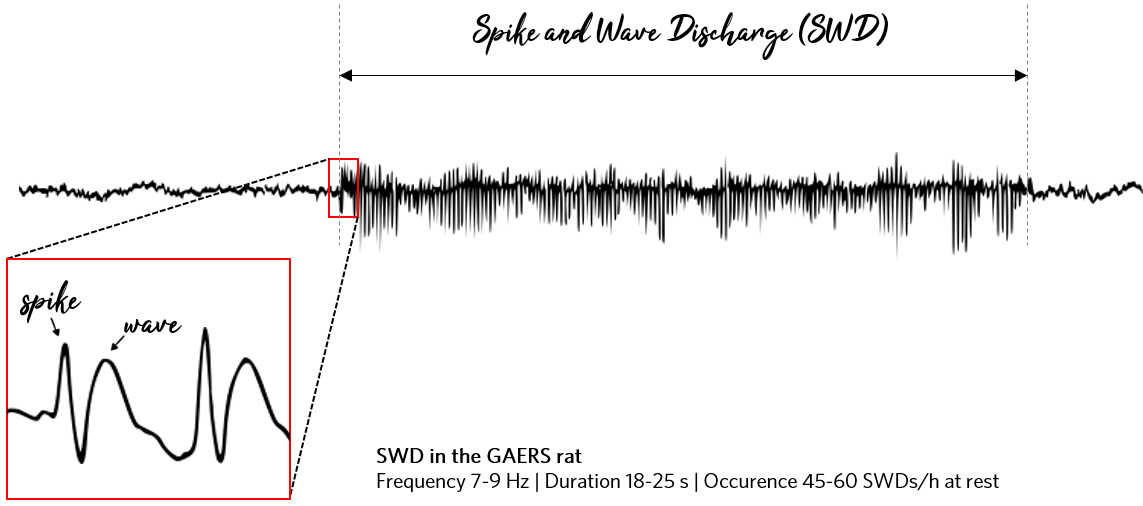
Absence Epilepsy is a particular form of epileptic syndrome where patients show generalized non-convulsive seizures characterized by a brief unresponsiveness to environmental stimuli and cessation of activity. In human, typical absence seizures are associated with bilateral, synchronous and regular spike and wave discharges (SWD) (Loiseau et al., 1995). These epileptiform patterns are characterized by the repetitive occurrence of a Spike followed by Slow Wave.
Pharmacological specificity of absence epilepsy
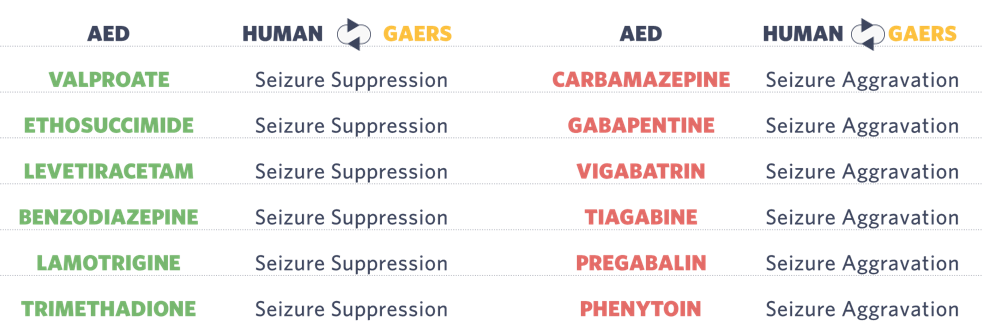
This type of epilepsy presents a specific pharmacology different from the one observed in other types of epilepsies. Therefore, careful evaluation of new antiepileptic drugs in development is mandatory regarding a possible aggravation of SWD in idiopathic generalized epilepsies (Manning et al., 2003; Genton, 2000) and particularly absence epilepsy.
The GAERS Model : A reference for absence epilepsy studies
The genetic absence epilepsy rat from Strasbourg (GAERS) is a selectively inbred strain of Wistar rats displaying spontaneous SWD. For the past thirty years, the GAERS has become a reference model for absence epilepsy, since these rats were shown to present behavioral, electrophysiological, and pharmacological features of absence seizures (Depaulis et al., 2016).
EEG characteristics of SWD in GAERS rats
Cortical EEG recording is characterized by SWD lasting 18-25 sec, with a recurrence of 45-60 seizures per hour. SWD start and end abruptly and are associated with a behavioral arrest lasting the time of the discharge (Vergnes et al., 1982).
Antiepileptic drug response in SWD models
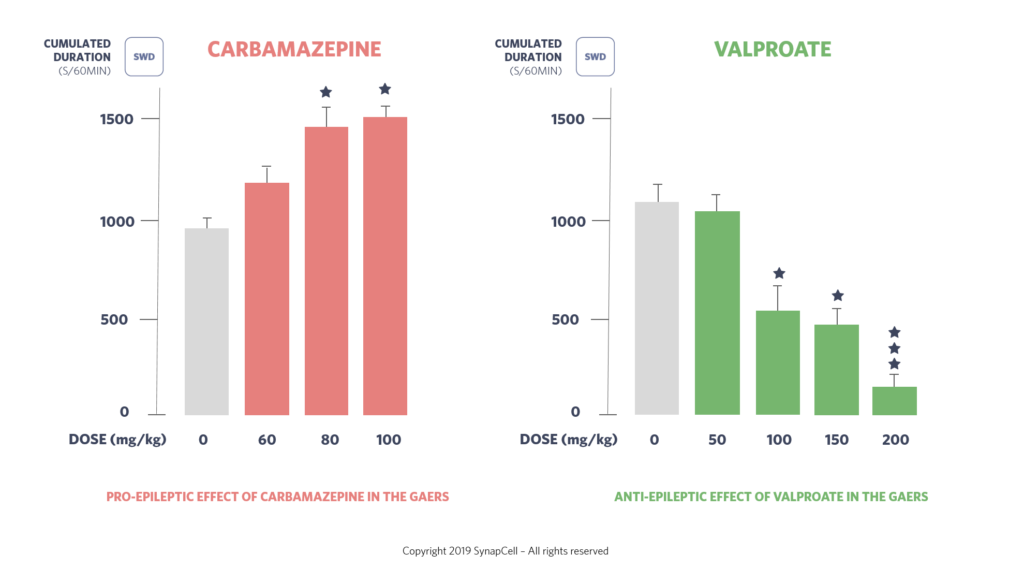
As in human patients, SWD in GAERS are suppressed by antiepileptic drugs (AED) such as valproate (Dedeurwaerdere et al., 2011), ethosuximide (Nehlig et al., 1993) and levetiracetam (Gower et al., 1995), whereas other AEDs have no efficacy (lacosamide, Higgins et al., 2010) or can even aggravate SWD, particularly carbamazepine (Wallengren et al., 2005), phenytoin (Gurbanova et al., 2006), and high doses (>200mg/kg) of pregabalin (Vartanian et al., 2006).
SWD as a predictive biomarker in epilepsy research
The use of SWD as a biomarker for absence epilepsy therefore offers very high predictivity level for identifying anti-absence as well as pro-epileptic effect for AED in development or other compounds acting on the CNS (Klitgaard et al., 2002; van Luijtelaar et al., 2002).
FAQ - Spike-and-Wave Discharges (SWD)
What are Spike-and-Wave Discharges?
Electroencephalographic patterns composed of a spike followed by a slow wave, typically associated with absence epilepsy.
Why are SWD important in preclinical epilepsy research?
They provide a reliable and quantifiable biomarker to study generalized non-convulsive seizures and evaluate antiepileptic drug responses.
Which preclinical model is most used to study SWD?
The GAERS model, which displays spontaneous SWD and recapitulates behavioral and electrophysiological features of human absence epilepsy.
Are all antiepileptic drugs effective on SWD?
No. Some AEDs suppress SWD, while others have no effect or can aggravate them, making pharmacological characterization essential.
What makes SWD a predictive biomarker?
Their stability, recurrence, and similarity to human absence seizures enable high translational value for assessing anti-absence compounds.